Shrinking down to the atomic scale
The global machine that builds them
Powering the next generation of tech
Beyond the silicon wall

play_review Understand the incredibly small physical scale of a nanometer and see how it relates to the future of 2-nanometer microchip technology.
Which physics phenomenon causes electrons to spontaneously slip through ultra-thin barriers in tiny chips?
Why is the gate-all-around (GAA) transistor design superior to older FinFET designs?

play_review Stack microscopic transistors to learn how 2-nanometer microchips power future tech.
play_review Watch how the gate-all-around (GAA) transistor design breakthrough is powering the future of 2-nanometer microchips and next-gen technology.

play_review The gate-all-around design wraps the transistor's control gate around all sides of the channel to prevent electrical leaks.
Which material do engineers use to insulate and prevent quantum tunneling in 2-nanometer chips?
Approximately how many transistors can fit on a fingernail-sized 2-nanometer microchip?
play_review Atomic Scale Shrinking
Ten atoms wide, ten atoms wide! Our future is ten atoms wide.
play_review Learn how shrinking transistors to the 2-nanometer scale creates faster, more powerful microchips to drive the future of computing technology.
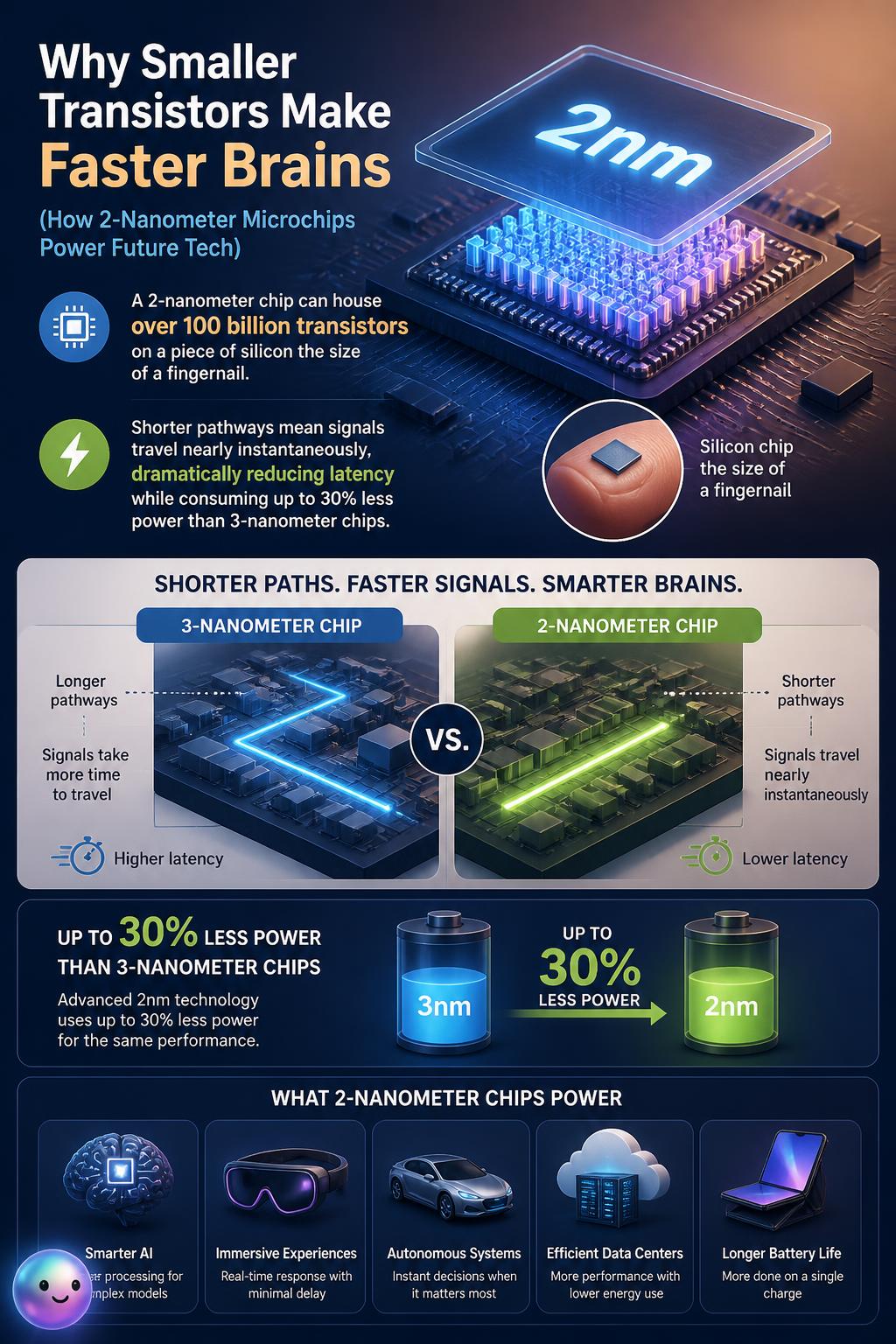
play_review Packing billions more transistors onto a single chip shortens the distance electrical signals must travel, boosting speed.
Microchip scale: A single strand of human DNA is about 2.5 nanometers wide, meaning 2-nanometer transistors are literally smaller than our genetic code.
play_review Discover how engineers prevent quantum tunneling leaks in 2-nanometer microchips to power future technology. Watch now to learn more.
How does a 2-nanometer microchip's energy consumption compare to a 3-nanometer chip?
A semiconductor device used to amplify or switch electrical signals and power. IBM unveiled a 2-nanometer chip in 2021, packing fifty billion transistors onto a single fingernail-sized wafer.