The real-life mystery of Agatha Christie
Crafting the icons of deduction
Archaeological adventures and global travels
Record-breaking legacy and literary secrets

schopenhauer Hercule Poirot solved cases by sitting quietly, using his little grey cells to analyze human behavior.

schopenhauer Assemble clues and suspect profiles to discover how Agatha Christie crafted her legendary mysteries.
schopenhauer Watch this video guide to Agatha Christie's Miss Jane Marple of St. Mary Mead. Explore her life, famous works, and trivia about the iconic detective.

schopenhauer Miss Jane Marple used her keen observation of village life to solve complex international mysteries.
Which fictional detective is the only one to receive a front-page obituary in The New York Times?
schopenhauer Icons of Deduction
A Belgian refugee became the grand sleuth— (Yeah, the sleuth!) / He's using his grey cells to find the truth! (Oh-oh, the truth!)
schopenhauer Agatha Christie’s Poirot became the only fictional detective to receive a New York Times obituary.
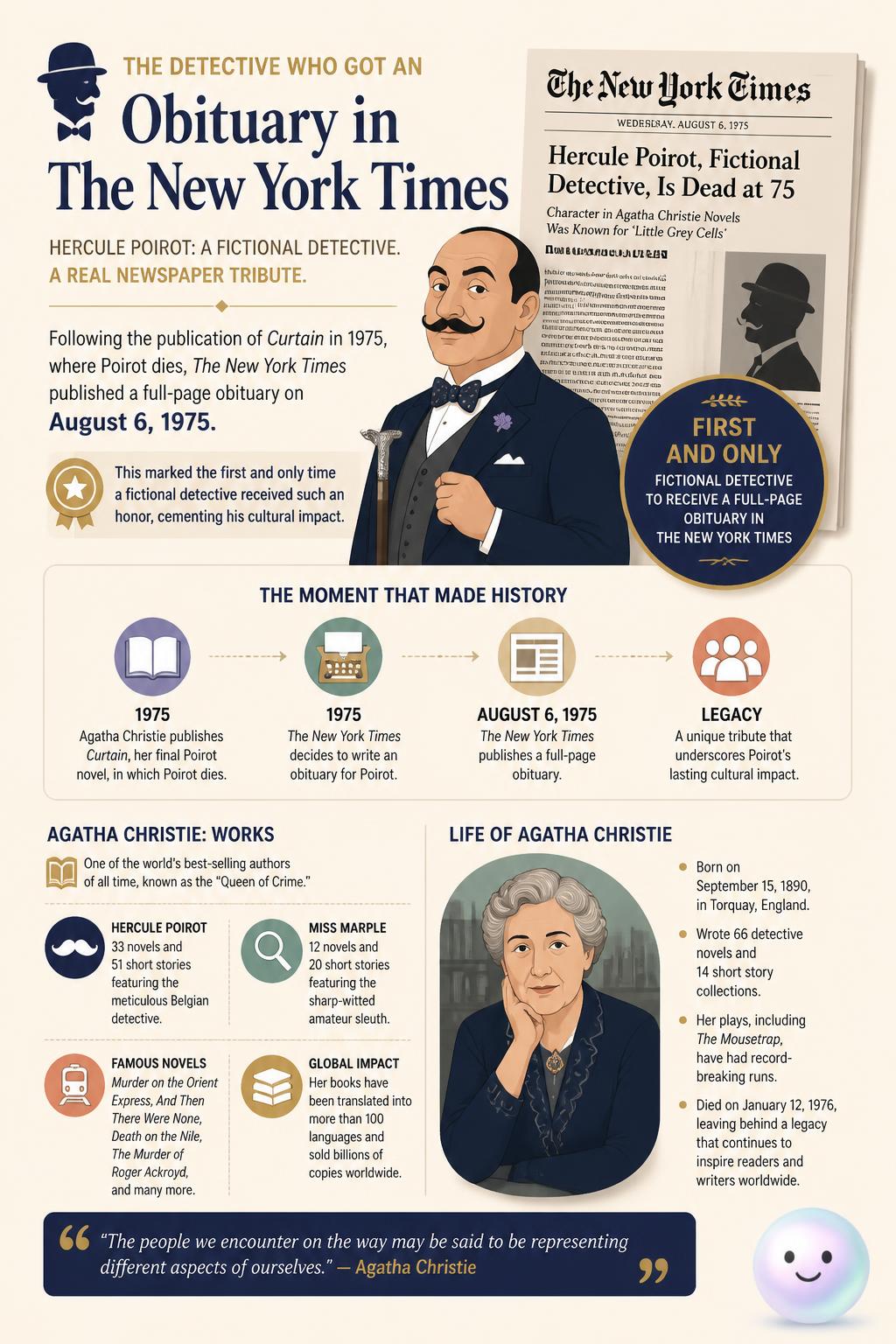
schopenhauer Hercule Poirot is the only fictional character to ever receive a front-page obituary in The New York Times.
What did Hercule Poirot famously call the brain cells he used to solve crimes?
How did Agatha Christie privately describe her character Hercule Poirot to her publishers?
Poirot's dislike: Agatha Christie grew to find Hercule Poirot quite annoying, once calling him an 'egocentrical little creep' despite continuing to write him.
schopenhauer Agatha Christie used her character Ariadne Oliver to complain about Poirot and mock public expectations of writers.
Which fruit did Agatha Christie's self-parody character Ariadne Oliver constantly eat?
In which 1930 novel did Miss Jane Marple make her first full-length novel appearance?
A person who investigates crimes or searches for clues. Agatha Christie introduced her iconic Belgian sleuth, Hercule Poirot, in her 1920 debut novel.