

BETA
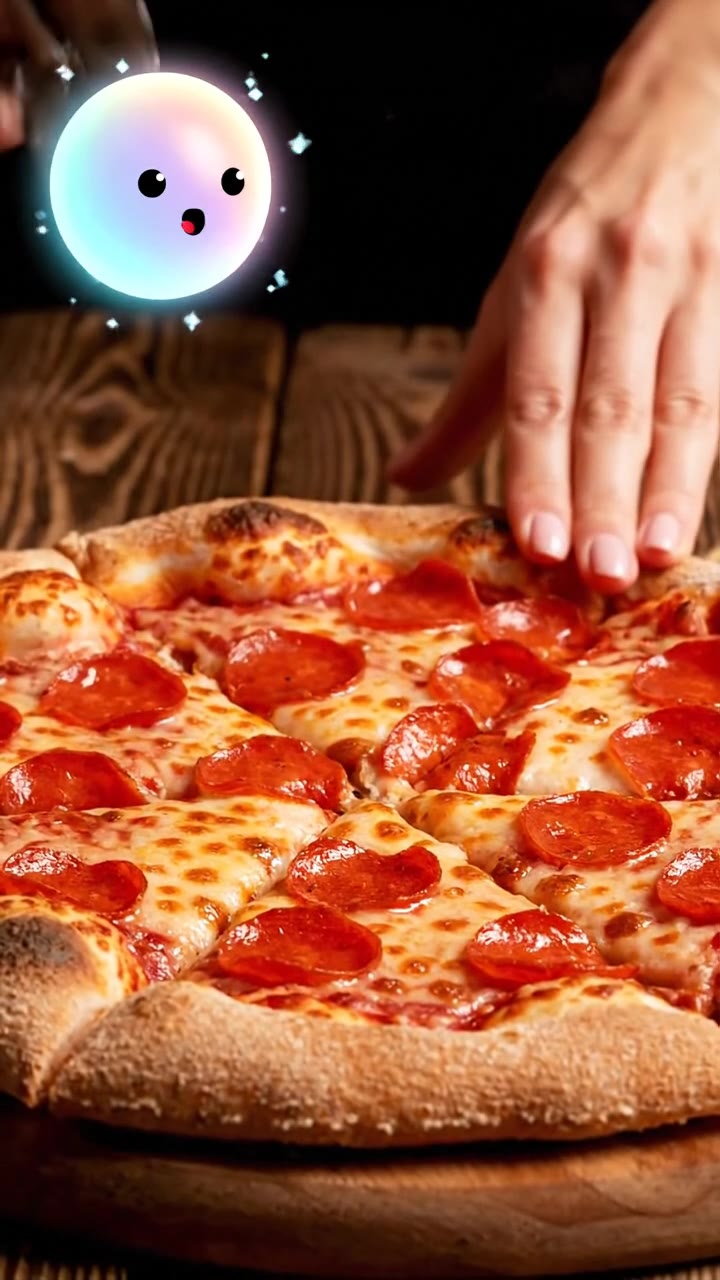
If you make 3 cuts (6 slices) or 5 cuts (10 slices) through an off-center point, the person who gets the slice containing the actual center of the pizza always gets more total area. This quirk was formally published in a 1994 mathematical proof.
artiteacher Slice the pizza at different angles to master the hidden math of fair sharing.
artiteacher The Pizza Theorem
Any way you slice it, any way you slice it, it's still a perfect share!

artiteacher The Pizza Theorem applies perfectly to both the total area and the crust length.
Pizza Theorem origin: In 1967, mathematician L. J. Upton proposed the Pizza Theorem as a puzzle in a mathematics magazine.

artiteacher You need at least eight slices for off-center fair sharing to work perfectly.
What is the minimum number of slices needed for the Pizza Theorem to guarantee equal shares?
If you make 12 slices through an off-center point at equal angles, how many slices does each of the two people get?
If a pizza is sliced through an off-center point at equal angles, how do two people share it equally?
In what year was the first formal mathematical proof of the Pizza Theorem published?
What did mathematicians Mabry and Deiermann prove about the Pizza Theorem in 1994?