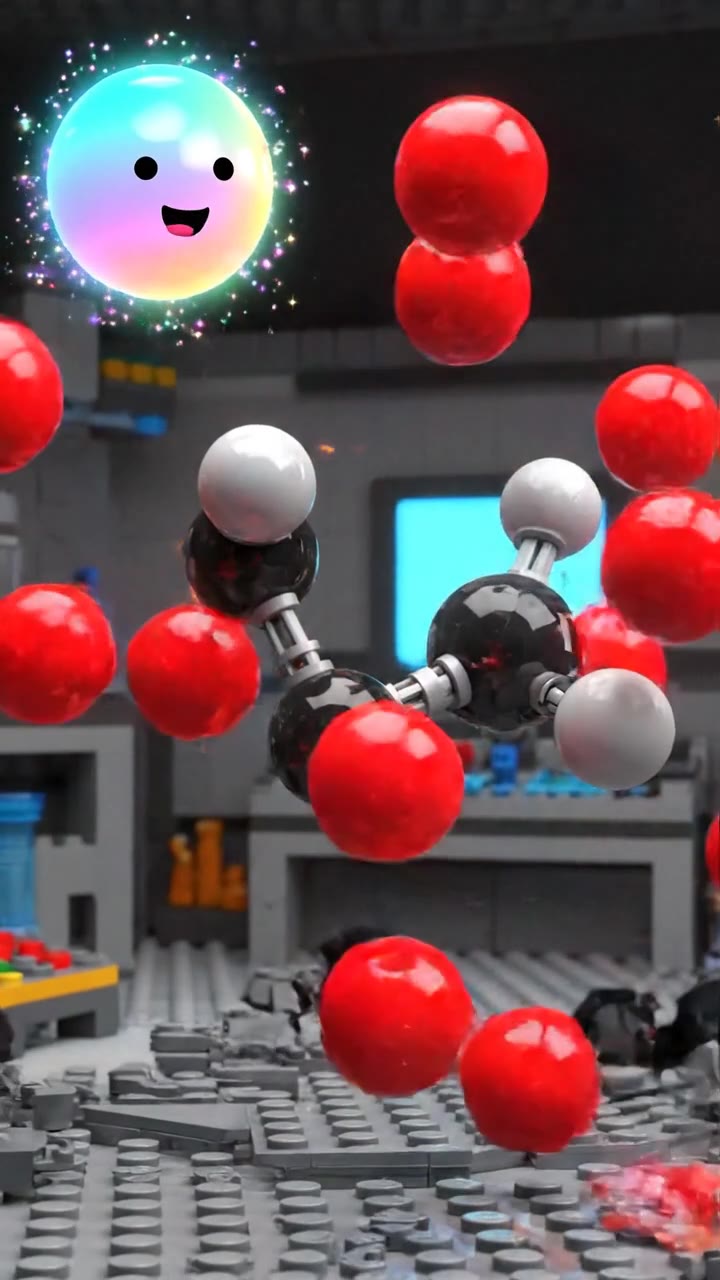
The combustion reaction
In 1777, French chemist Antoine Lavoisier discovered that combustion requires oxygen. When fuel heats up, its carbon and hydrogen atoms unlock from each other, rapidly bonding with oxygen to form carbon dioxide and water vapor.
The chemical building blocks of fire
How humans mastered the spark
Dismantling the fire triangle
Modeling fire with plastic bricks

lego In a LEGO world, the fire triangle explains that removing heat, fuel, or oxygen stops fire.
lego In a LEGO world, fire glows yellow when tiny carbon soot particles exceed 1,000 degrees Celsius.

lego During combustion, carbon and hydrogen atoms in heated fuel unlock and rapidly bond with oxygen.
lego Watch how fire works and learn the science behind a flame's shape in a world built entirely out of LEGO bricks.
lego LEGO Fire Chemistry
Tear those fuel and oxygen bonds apart, and watch them snap together into water and CO2!

lego The bright orange color of a flame comes from tiny, glowing particles of unburned carbon.
Blue space flames: In zero gravity, flames burn as perfect blue spheres because convection currents do not exist to pull them upward.

A nonmetallic chemical element that readily forms compounds and is a primary component of organic fuel. Black LEGO bricks serve as these fuel elements, linking with oxygen studs to simulate active combustion.
At approximately what temperature do soot particles glow yellow in a typical wood fire?
What solid particles glow to give a typical campfire flame its bright orange and yellow color?