
Why do microchip fabs require millions of gallons of water?
Test your knowledge on semiconductor manufacturing. Find out why chip fabrication plants consume massive amounts of water daily in this quick quiz.
Chapter 1
Shrinking down to the atomic scale
Chapter 2
The global machine that builds them
Chapter 3
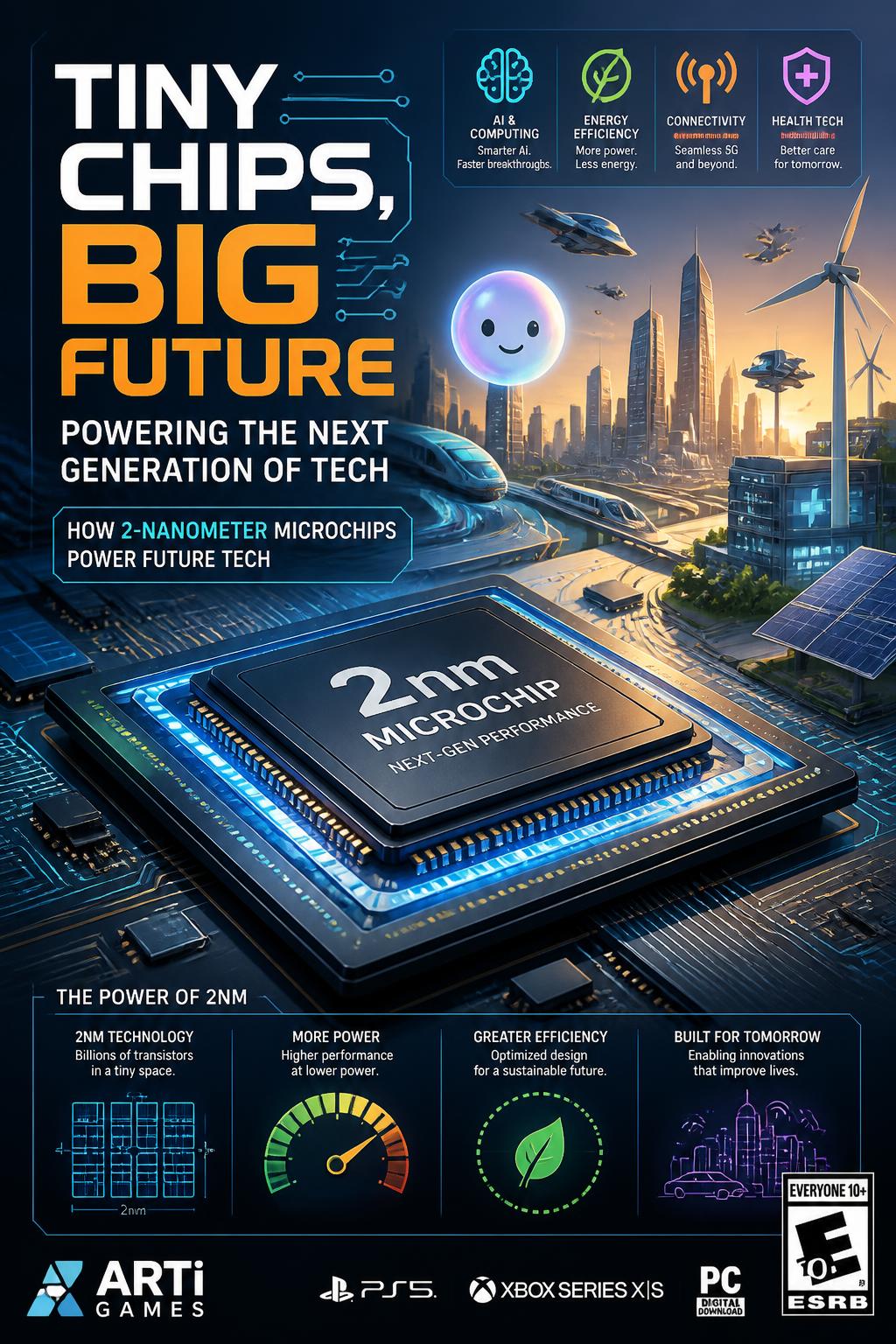
Powering the next generation of tech
Chapter 4
Beyond the silicon wall
Ch 3 · Powering the next generation of tech

play_review Two-Nanometer Microchips
Fifty billion gates on a tiny chip, saving seventy-five percent of our power
play_review Discover how 2-nanometer microchips provide the processing power needed for self-driving cars to make instant, life-saving decisions.

play_review Self-driving vehicles rely on instant sensor processing, where 2-nanometer chips provide the rapid decision-making required for safety.
Fun Fact
Clean water: A single advanced microchip factory can use more water in a day than a small city of 50,000 people.

play_review Mobile processors built on 2-nanometer technology will drastically extend phone battery life while enabling real-time on-device AI.
Glossary
transistor (noun)
A semiconductor device used to amplify or switch electrical signals and power. In 2021, IBM built the first two-nanometer chip, housing fifty billion transistors on one tiny die.
A semiconductor device used to amplify or switch electrical signals and power. In 2021, IBM built the first two-nanometer chip, housing fifty billion transistors on one tiny die.
BETA
play_review Drag tiny transistors into place to discover how 2-nanometer chips power future technology.
play_review Watch how next-generation 2-nanometer microchips are set to revolutionize smartphone battery life, keeping your mobile devices powered for days.
Quiz
Approximately how much water can a modern semiconductor manufacturing fab consume daily?
play_review Watch how 2-nanometer microchips are supercharging artificial intelligence and revolutionizing efficiency in modern data centers.
play_review Learn about the massive energy and resource footprint of cleanroom manufacturing used to produce next-generation 2-nanometer microchips.
Quiz
How long could future smartphone batteries last thanks to 2-nanometer chip efficiency?
Quiz
What is a major benefit of running AI models locally on a 2-nanometer smartphone chip?